The Social Reckoning: Everything You Need to Know About The Social Network Follow-Up
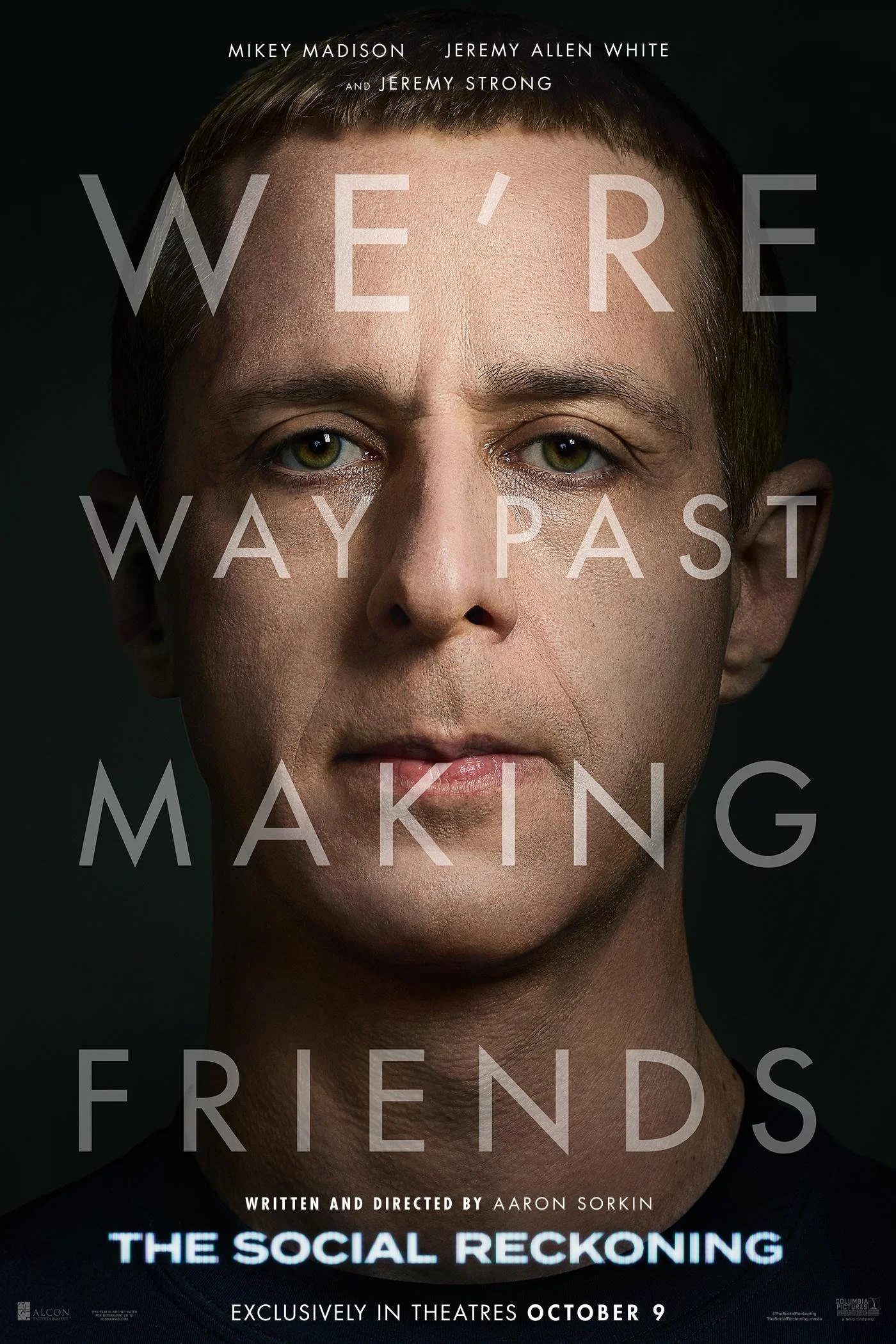
Sixteen years after The Social Network turned the creation of Facebook into one of the defining movies of its era, Aaron Sorkin is going back.
But The Social Reckoning is not simply The Social Network 2.
It does not return to Harvard.
It does not retell the battle between Mark Zuckerberg and the people who helped build Facebook.
And Jesse Eisenberg is not returning as Zuckerberg.
Instead, Sorkin jumps forward more than a decade to tell the story of what happened after Facebook became one of the most powerful companies in the world.
The movie centers on Frances Haugen, the former Facebook employee who became one of the most important whistleblowers in the company's history, and Jeff Horwitz, the Wall Street Journal reporter whose reporting helped produce the investigative series known as The Facebook Files.
Academy Award winner Mikey Madison plays Haugen.
The Bear star Jeremy Allen White plays Horwitz.
And Succession star Jeremy Strong takes over the role of Mark Zuckerberg.
Sony Pictures is officially calling The Social Reckoning a “companion piece” to The Social Network, rather than simply describing it as a sequel. The film opens exclusively in theaters on October 9, 2026.
Here is everything you need to know.
When Does The Social Reckoning Come Out?
The Social Reckoning opens in U.S. theaters on:
October 9, 2026.
Sony Pictures currently lists it as an exclusive theatrical release under Columbia Pictures.
Advance tickets are already available at major theater chains.
Is The Social Reckoning a Sequel to The Social Network?
Yes—but Aaron Sorkin and Sony are deliberately calling it a companion piece.
That wording is important.
The movie continues the broader story of Facebook and Mark Zuckerberg, but it does not simply pick up with the same characters immediately after the ending of the 2010 movie.
The Social Network was primarily about the creation of Facebook.
The Social Reckoning is about what happened after Facebook grew powerful enough to affect politics, journalism, elections, public discourse and the lives of billions of users.
Sony describes the new movie as a companion to the original and a David-and-Goliath story about Frances Haugen and Jeff Horwitz exposing some of Facebook's most closely guarded internal information.
That makes the two films almost mirror images.
The first movie asks:
How was Facebook built?
The new movie asks:
What happened after it became powerful enough to reshape society?
What Is The Social Reckoning About?
The movie is inspired by true events surrounding the Facebook whistleblower scandal that eventually led to The Facebook Files.
Frances Haugen works inside Facebook.
She becomes increasingly concerned about internal research suggesting that the company understands serious problems involving its platforms but does not always act aggressively enough to address them.
She eventually begins working with Jeff Horwitz, a reporter at The Wall Street Journal.
What follows becomes a massive journalistic investigation.
Sony describes the film as the story of Haugen enlisting Horwitz to help expose the social network's “most guarded secrets.”
Among the issues associated with The Facebook Files were questions involving:
political extremism,
misinformation,
algorithmic amplification,
content designed to maximize engagement,
Instagram's impact on teenage users,
and what Facebook's internal research showed compared with what the company was saying publicly.
Vogue's profile of Mikey Madison notes that Haugen and Horwitz's reporting examined issues including extremist groups, misinformation after the 2020 election and Facebook's internal research concerning Instagram and teenage girls' mental health.
Who Is Frances Haugen?
Frances Haugen is a real former Facebook employee who became a whistleblower.
In 2021, she publicly identified herself as the source behind a massive collection of internal Facebook documents.
Those documents became the foundation for reporting by The Wall Street Journal and other news organizations.
Haugen later testified publicly about Facebook and its business practices.
Her central argument was not simply that social media could be harmful.
She claimed Facebook itself possessed research showing serious problems within its products.
That distinction is central to why her disclosures became so significant.
In the movie, Haugen is played by Mikey Madison.
Mikey Madison Plays Frances Haugen
Mikey Madison enters The Social Reckoning after winning the Academy Award for Anora.
Her casting is interesting because Sorkin apparently did not try to make her physically identical to Frances Haugen.
Madison told Vogue that preparing for the role was more about understanding Haugen's mind, emotional restraint and analytical personality than reproducing her exact appearance.
That fits Sorkin's approach to historical drama.
His movies frequently prioritize the dramatic truth of how people think and argue rather than creating literal impersonations.
Madison's Haugen appears to be positioned as one of the movie's moral and intellectual centers.
Who Is Jeff Horwitz?
Jeff Horwitz is the Wall Street Journal reporter who became central to the publication of The Facebook Files.
Jeremy Allen White plays him in the film.
The story follows Horwitz and Haugen as they build a working relationship while dealing with extraordinarily sensitive internal material.
Their dynamic appears to be one of the movie's primary engines.
Vogue described scenes between them in which the two debate data, Facebook's algorithms and the implications of the information Haugen is providing.
Sorkin has built much of his career around characters exchanging huge amounts of information through rapid dialogue.
A whistleblower and investigative reporter trying to understand thousands of pages of internal corporate research is essentially perfect Sorkin material.
Jeremy Allen White Plays Jeff Horwitz
Jeremy Allen White has spent recent years becoming one of television's biggest stars through The Bear.
The Social Reckoning gives him a very different type of role.
Instead of a chef under pressure, White plays a journalist trying to turn complicated corporate documents into reporting ordinary readers can understand.
That matters because the Facebook story is filled with:
algorithms,
internal reports,
company policies,
data,
ranking systems,
content moderation,
and technology terminology.
One of Sorkin's challenges is transforming that information into a thriller.
Horwitz becomes the character whose job is essentially to ask:
What does this information actually mean?
And:
How do we prove it?
Jeremy Strong Is the New Mark Zuckerberg
One of the movie's biggest changes from The Social Network is obvious.
Jesse Eisenberg is not playing Mark Zuckerberg.
Instead:
Jeremy Strong plays Zuckerberg.
Strong is best known for playing Kendall Roy in Succession and previously worked with Aaron Sorkin in The Trial of the Chicago 7.
That casting gives the new film a fundamentally different Zuckerberg.
Eisenberg's Zuckerberg was a young programmer building Facebook.
Strong's Zuckerberg is playing a man who has now spent years at the center of one of the most influential technology companies on Earth.
Strong told The New Yorker that he tried to approach Zuckerberg with empathy rather than treating him simply as a villain. He even attempted to contact Zuckerberg as part of his preparation and argued for the character's perspective during production.
That could make the performance more interesting than a straightforward condemnation.
Why Isn't Jesse Eisenberg Returning as Mark Zuckerberg?
Aaron Sorkin wanted him back.
Eisenberg declined.
Sorkin has said Eisenberg read and liked the script but was uncomfortable returning to Zuckerberg.
According to Sorkin, money was actually a disincentive for Eisenberg rather than something that could persuade him to take the role.
Eisenberg has previously expressed discomfort about being permanently associated with Zuckerberg, particularly because people often connect the actor visually with the real Facebook founder.
So Sorkin eventually cast Jeremy Strong.
That creates one of the strangest elements of the film for fans of the original.
The character is the same.
The actor is completely different.
Is David Fincher Directing The Social Reckoning?
No.
This is another major difference from the original film.
The Social Network was directed by David Fincher from Aaron Sorkin's screenplay.
The Social Reckoning is both:
written by Aaron Sorkin
and
directed by Aaron Sorkin.
Sony officially credits Sorkin as writer, director and producer.
Fincher is not directing the follow-up.
That means audiences should not necessarily expect the exact visual or tonal style of The Social Network.
Sorkin is returning to the world he wrote.
But he is doing so as the filmmaker in complete creative control.
Aaron Sorkin Has Become a Director Since The Social Network
When The Social Network was made, Sorkin was primarily known as a writer.
Since then, he has directed:
Molly's Game
The Trial of the Chicago 7
and
Being the Ricardos.
The Social Reckoning continues that transition.
It also gives Sorkin the chance to revisit one of his most celebrated scripts without having another filmmaker interpret the material.
Whether that makes the new movie feel more or less like The Social Network will probably become one of the biggest topics in reviews.
What Are The Facebook Files?
The Facebook Files refers to the investigative reporting based on internal Facebook documents that came into the possession of Frances Haugen and ultimately journalists including Jeff Horwitz.
The documents offered a rare look inside Facebook's own research.
That created an explosive question:
What did Facebook know about the consequences of its products?
The investigation explored numerous subjects.
Among them were concerns over how Facebook's systems could reward divisive material because anger and controversy often produce engagement.
The reporting also examined internal research surrounding Instagram and younger users.
That investigation provides the factual backbone for The Social Reckoning.
Is The Social Reckoning a True Story?
It is inspired by true events.
Sony uses that wording explicitly.
Frances Haugen is real.
Jeff Horwitz is real.
Mark Zuckerberg is real.
The Facebook Files are real.
But this is still a dramatized feature film.
That means conversations can be compressed, events can be reordered and some characters or situations can be altered for storytelling and legal reasons.
Sorkin recently acknowledged that lawyers required adjustments to portions of the screenplay.
Vanity Fair reported that some characters were fictionalized or altered to reduce legal exposure.
So audiences should view it as a historical drama based on real events rather than a documentary.
Why Doesn't the Movie Use Donald Trump's Name?
The film deals with the political environment around the 2020 election and the January 6 attack on the U.S. Capitol.
But Sorkin deliberately avoids using Donald Trump's name.
He explained that he did not want one politician to become the focus of a story he sees as being about Facebook's larger role in amplifying political division.
The film apparently refers to political events without making Trump himself the central subject.
That decision tells us something about what Sorkin wants the movie to argue.
The target is not one politician.
It is the system.
Who Is in The Social Reckoning Cast?
The principal cast includes:
Mikey Madison as Frances Haugen
Jeremy Allen White as Jeff Horwitz
Jeremy Strong as Mark Zuckerberg
Wunmi Mosaku
Betty Gilpin
Billy Magnussen
Bill Burr
Patrick Fischler
Anna Lambe
Gbenga Akinnagbe
Portia Doubleday
Sony officially highlights Madison, White, Mosaku, Gilpin, Magnussen, Burr and Strong in its principal cast.
How Long Is The Social Reckoning?
The Social Reckoning runs approximately:
1 hour and 52 minutes.
Fandango and Rotten Tomatoes both list a 112-minute runtime.
That makes it slightly shorter than many modern studio dramas and much shorter than the three-hour blockbusters currently common in theaters.
What Is The Social Reckoning Rated?
The movie is rated:
R for language.
Rotten Tomatoes currently lists the official MPA rating as R.
That suggests the mature rating is driven primarily by dialogue rather than violence or sexual content.
Given Aaron Sorkin's style, a movie getting an R largely because people talk aggressively is probably appropriate.
Do You Need to Watch The Social Network First?
Technically, no.
Sony is positioning The Social Reckoning around a new central story involving Haugen and Horwitz.
You should be able to follow the basic plot without seeing the 2010 movie.
But you should absolutely watch The Social Network first if you have the opportunity.
The two movies represent opposite ends of the same story.
The Social Network shows Facebook becoming powerful.
The Social Reckoning shows people trying to hold it accountable after it became powerful.
Watching them together also gives the recasting of Zuckerberg additional weight.
What Happened at the End of The Social Network?
The original film ends with Zuckerberg alone.
Facebook has become enormously successful.
Eduardo Saverin has sued him.
The Winklevoss twins have settled their case.
Zuckerberg sends a Facebook friend request to Erica Albright and repeatedly refreshes the page waiting for her response.
It's a deliberately small and lonely ending to a movie about building one of the largest social networks on Earth.
The Social Reckoning begins from a world where that company is no longer a startup.
It has become infrastructure.
And the stakes have gone from friendships and ownership percentages to questions involving democracy, public health and social stability.
Is The Social Reckoning About Meta or Facebook?
The historical events primarily concern Facebook, including the broader company and its platforms such as Instagram.
Facebook changed its corporate name to Meta in October 2021, around the same period in which the Haugen disclosures became international news.
But the events dramatized in the movie are deeply connected to the Facebook name because that was the company identity associated with much of the reporting.
Is The Social Reckoning Anti-Facebook?
The movie is clearly critical of Facebook.
But Jeremy Strong's comments suggest the filmmakers did not want Zuckerberg played simply as a cartoon villain.
Strong has said he tried to understand Zuckerberg's internal logic and advocate for the character's perspective.
That tension will probably be important.
A compelling drama needs more than:
Facebook bad.
The more interesting question is how intelligent people convince themselves that decisions with enormous consequences are justified.
That is exactly the type of conflict Sorkin likes writing.
Does The Social Reckoning Have Reviews Yet?
As of October 5, 2026, the movie has screened for some press and at European premiere events, but Rotten Tomatoes does not yet display a meaningful Tomatometer or audience score.
Its official page currently lists the film as coming October 9 without an aggregate percentage.
That means any numerical claim about its Rotten Tomatoes reception would currently be premature.
Early individual reactions are appearing, but the broader critical consensus will become clearer as the review embargo fully lifts and the movie opens.
Is The Social Reckoning Expected to Be an Awards Movie?
It certainly has the ingredients.
Aaron Sorkin.
Mikey Madison.
Jeremy Allen White.
Jeremy Strong.
A major real-world subject.
An October theatrical release.
Sony Pictures.
And a connection to a movie that won three Academy Awards.
But none of that guarantees nominations.
The critical response will matter enormously.
The original Social Network was not merely successful because its subject was important.
It was also widely regarded as one of the best movies of its decade.
That creates a very high standard for the follow-up.
Why The Social Network Is Such a Difficult Movie to Follow
The problem with making a follow-up to The Social Network is that the first movie's reputation only grew after release.
It won Oscars for:
Best Adapted Screenplay
Best Film Editing
and
Best Original Score.
It was also nominated for Best Picture.
Over time, it became widely regarded as one of the defining films of the 2010s.
So The Social Reckoning is not merely being compared with other 2026 dramas.
It is being compared with:
David Fincher,
Jesse Eisenberg,
Andrew Garfield,
Justin Timberlake,
Trent Reznor and Atticus Ross,
and one of Aaron Sorkin's most celebrated screenplays.
That's an intimidating sequel.
How to Watch The Social Reckoning in Spanish
As of October 5, 2026, we can confirm that The Social Reckoning is opening widely in U.S. theaters on October 9.
What we cannot yet confirm publicly is a dedicated nationwide Spanish Spoken / En Español theatrical version.
Cinemark currently lists The Social Reckoning for advance tickets, but unlike titles such as Verity and Heart of the Beast, its publicly indexed movie pages do not currently show a separate [En Español] version.
That could change as individual theaters finalize showtimes closer to October 9.
If you specifically want to hear the movie dubbed in Spanish, check the language label attached to your local showtime before purchasing.
Look for terms such as:
Spanish Spoken
En Español
Spanish Dubbed
or
Doblado en Español.
Does TheaterEars Have The Social Reckoning?
As of October 5, TheaterEars' public Current Releases page does not list The Social Reckoning.
Because the movie does not open until October 9, that status could change.
For now, it would be premature to promise that a TheaterEars Spanish track will be available.
Check the TheaterEars app as the release date approaches.
What Is The Social Reckoning Called in Spanish?
International markets may use localized titles.
IMDb currently lists the Argentine title as:
El poder de la red.
In the United States, however, theaters currently market the movie under its English title:
The Social Reckoning.
If searching for Spanish-language showtimes, try both the English title and language terms such as En Español or Spanish Spoken.
Frequently Asked Questions About The Social Reckoning
When does The Social Reckoning come out?
The Social Reckoning opens exclusively in theaters on October 9, 2026.
Is The Social Reckoning a sequel to The Social Network?
It continues the Facebook story, but Sony and Aaron Sorkin describe it as a companion piece rather than simply calling it The Social Network 2.
Who plays Frances Haugen?
Mikey Madison.
Who plays Jeff Horwitz?
Jeremy Allen White.
Who plays Mark Zuckerberg?
Jeremy Strong plays Zuckerberg in the new film.
Is Jesse Eisenberg in The Social Reckoning?
No. Eisenberg declined to reprise Mark Zuckerberg, and Jeremy Strong took over the role.
Is David Fincher directing?
No. Aaron Sorkin wrote and directed The Social Reckoning.
Is The Social Reckoning based on a true story?
Yes. It is inspired by real events involving Frances Haugen, Jeff Horwitz and the reporting that became The Facebook Files.
What are The Facebook Files?
They were a major series of reports based on internal Facebook documents that examined what the company knew about issues involving its platforms, algorithms, misinformation, extremism and user safety.
How long is The Social Reckoning?
Approximately 1 hour and 52 minutes.
What is The Social Reckoning rated?
R for language.
Do I need to watch The Social Network first?
No, but it is highly recommended because The Social Reckoning intentionally continues the larger story established in the original film.
Is The Social Reckoning available in Spanish?
A dedicated U.S. Spanish-dubbed theatrical version is not yet clearly confirmed in publicly indexed theater listings as of October 5. Check individual showtimes as the October 9 release approaches.
Is The Social Reckoning on TheaterEars?
The public TheaterEars Current Releases page does not list it as of October 5. Check the TheaterEars app closer to release.
Is The Social Reckoning streaming?
No. Sony is releasing the film exclusively in theaters on October 9.
The Social Reckoning Asks What Happened After Facebook Won
The genius of the title The Social Network was that in 2010 it could still sound almost neutral.
A social network.
A website connecting people.
A brilliant idea built in a college dorm.
Sixteen years later, the word social carries a very different weight.
Algorithms decide what billions of people see.
Platforms can elevate anger faster than moderation can contain it.
Private technology companies make decisions that can affect elections, journalism, teenage mental health and political movements.
That is why The Social Reckoning is potentially such an interesting companion to the first film.
The Social Network ends when Facebook wins.
The company survives the lawsuits.
It becomes enormous.
Mark Zuckerberg becomes unimaginably wealthy.
The network keeps growing.
The Social Reckoning asks what happens when society begins examining the cost of that victory.
Frances Haugen enters the company.
She sees internal information the public cannot see.
Jeff Horwitz begins receiving documents.
The Wall Street Journal starts publishing.
Congress gets involved.
Facebook responds.
And suddenly the story is no longer about who owns what percentage of a website.
It is about who is responsible when that website becomes powerful enough to shape the world outside the screen.
Aaron Sorkin could have made another movie about the young Zuckerberg.
Instead, he waited until the Facebook story changed genres.
The first movie was an origin story.
The second is an investigation.
Jesse Eisenberg is gone.
Jeremy Strong is Zuckerberg now.
Mikey Madison and Jeremy Allen White become the characters driving the story.
And sixteen years after audiences watched Facebook being created, The Social Reckoning arrives with a much darker question:
What happens when the thing you built becomes bigger than anyone knows how to control?