“Whalefall” Filmmakers’ Commentary: A Deep Dive Into a Deeply Uncomfortable—and Deeply Moving—Movie
Even when you’re making a high-concept studio film, there are times when you have to work around an actor’s availability.
After some early test screenings of the survival film “Whalefall,” the filmmakers decided they needed to film a “pickup scene” to serve as a kind of familial epilogue to the main story. The cast and crew reassembled to shoot the scene, which had Austin Abrams’ Jay on a boat with his family—but Emily Rudd, who played Jay’s sister, Nan, wasn’t available due to a prior commitment.
So…the filmmakers used a body double. Throughout the scene, Nan’s back is to the camera as she looks out at the water, or she’s just out of frame. Once you know it, you can’t unsee it.
Filmmaking is collaboration. Filmmaking is adjusting to the moment. Filmmaking presents new challenges every day.
This is why I love listening to commentaries by directors, writers and editors. You get a backstage pass to the decisions, happy accidents, technical challenges, and occasional workarounds that go into making a film. In the case of “Whalefall,” there’s a whole lot to talk about.
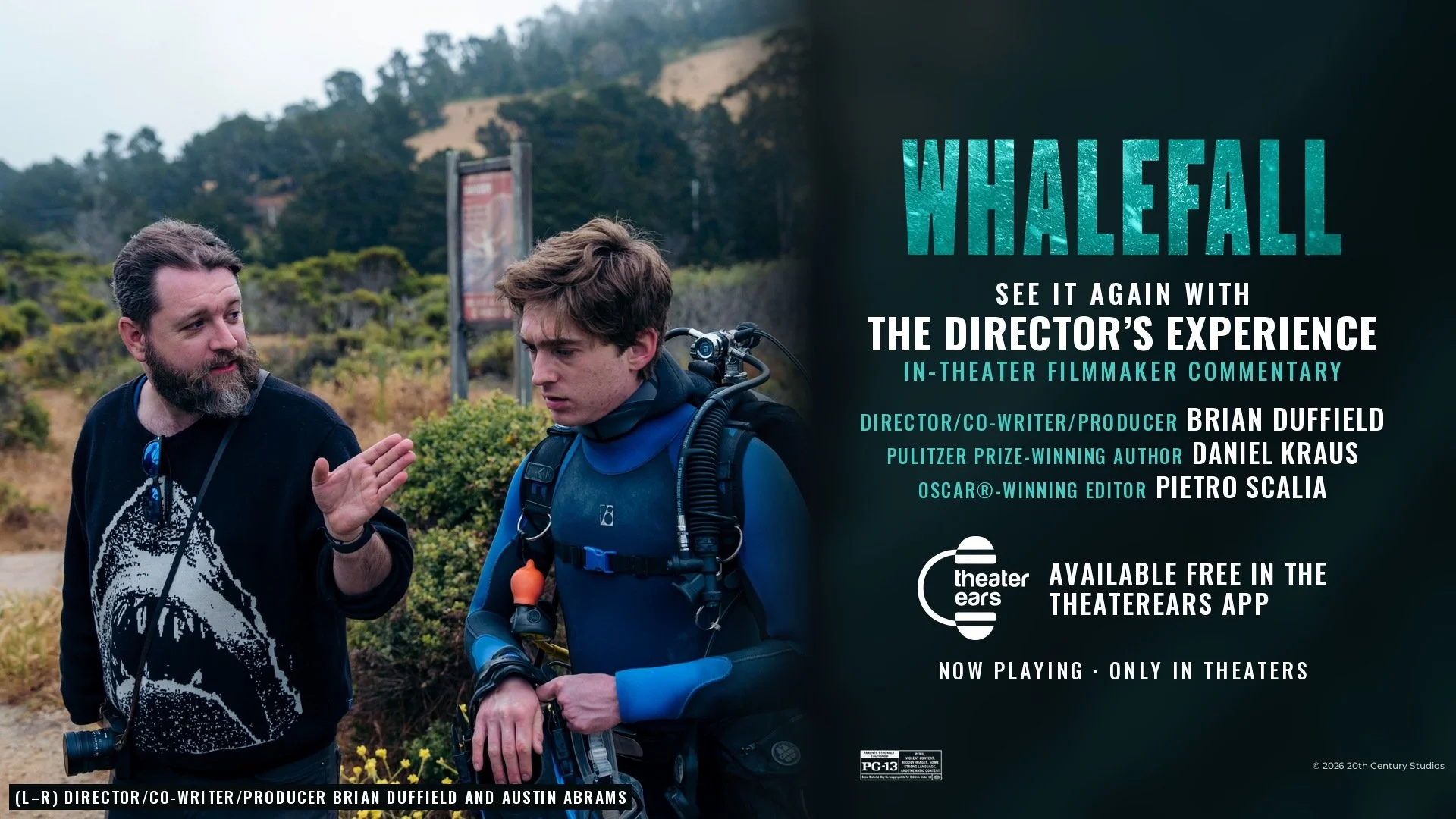
The commentary features the talented director, co-writer, and producer Brian Duffield; the acclaimed novelist Daniel Kraus, whose book inspired the film and who is the co-writer of the adaptation; and editor Pietro Scalia, a two-time Oscar winner. That’s a seriously credentialed bunch. They bring different perspectives to the proceedings, although I would have liked to hear a little more from Scalia. That’s the occasional problem with group commentaries: when one of the voices belongs to the director, that voice is almost sure to be the dominant one. It’s the nature of being a director, I suppose. Not that Duffield isn’t a warm and generous conversationalist; he just has the most to say.
There’s plenty of good stuff from all three, starting with the sheer logistical challenge of making a movie in which a man spends much of the story trapped inside a whale. Duffield discusses the difficulties of depicting the whale’s interior, explaining which sequences were shot in Monterey Bay, San Pedro and Catalina Island, and which were filmed within the confines of a relatively small tank in Studio City. He also points out practical effects and computer-generated imagery, giving us a better appreciation of how those elements were combined.
The director reminds us that the submerged Monterey Canyon is deeper than the Grand Canyon, putting the film’s already terrifying premise into perspective. He also explains how some scenes supposedly taking place at sunset were actually shot at sunrise. Movie magic.
“Whalefall” is one of the most claustrophobic movies I’ve ever seen, and I do NOT do claustrophobia. There’s something anxiety-inducing about watching Abrams’ Jay struggle to survive in a space where the walls are closing in on him, with limited air and dwindling options. (And what a powerful performance by Abrams, who has been THROUGH IT in recent movies such as “Resident Evil,” “Weapons” and “Wolfs.” Give this guy a rom-com!)
The commentary makes the filmmaking choices behind that experience easier to appreciate. Duffield talks about framing Jay in entombed spaces, including an early scene of foreshadowing in which Jay sits inside his closed-up car. Scalia discusses establishing the connection between Jay’s breathing and the water. And thankfully, Scalia’s editing gives us well-timed relief throughout the film, cutting away from the suffocating confines of the whale and returning us to the world above, allowing us to breathe again. Even though the bulk of scenes between Josh Brolin’s Mitt and Jay are intense reminders of their difficult father-son relationship, it’s still a relief from watching Jay trapped, you know, INSIDE A WHALE. Those transitions were particularly resonant for me. I needed those moments of open space before we plunge back into Jay’s desperate predicament, where he sometimes has literally inches of room to work.
While “Whalefall” is primarily an exercise in survival-movie suspense, it’s also an unexpectedly emotional film. As Duffield notes, they took a “big swing” with the material, particularly a 15-minute sequence in which Mitt essentially becomes the whale. It either works or it doesn’t. I thought it was admirably brave and beautifully executed, elevating the film to something special.
The commentary also provides illuminating details about the family dynamics. Kraus says Jay’s sisters were based on his own sisters, and he points out that the film’s character names carry Biblical significance. He even reveals that his favorite scene is autobiographical, although I’ll leave that one unspoiled.
Duffield is particularly adept at explaining how he works with actors. He likes long takes because they showcase their talents. He also notes that when actors have ideas, he generally listens because they know their characters better than anyone. Their instincts are often the best guide.
One of the commentary’s best stories involves an intense swimming sequence. Abrams was given a safe word — “Penguin!” — to use if he needed a break. He never said it, leading the filmmakers to believe he was being incredibly tough. Only later did they learn the truth: he was so cold he couldn’t get the word out. Duffield affectionately jokes that he’s grateful they didn’t kill off Austin Abrams.
Other anecdotes are just plain entertaining. A note Jay leaves saying, “TOOK THE CAR, WENT TO GET COFFEE,” was misread by some test-screening viewers as saying, “TOOK THE CAT, WENT TO GET COFFEE.” Now, that’s an entirely different kettle of fish! The filmmakers used a little CGI to make the lettering clearer. Duffield also recalls Brolin’s frustration with sharing screen time with a crying newborn during a flashback, noting that Brolin loves babies and was doing intense acting while the baby was having none of it. (Actors!) And then there’s some fun banter about the jellyfish Abrams nicknamed Buddy, which becomes a sort of companion and even a makeshift flashlight for Jay. Think Wilson in “Cast Away.”
The commentary even offers a glimpse into the film’s rating. Duffield says he included some particularly gruesome material in the original cut, anticipating that the Motion Picture Association would demand cuts to secure a PG-13 rating.
“Whalefall” is a technically ambitious, relentlessly claustrophobic survival thriller with a beating heart. That last part is what makes it one of the best films of 2026. The filmmakers’ insights explain how they pulled off these incredibly difficult sequences, shining a light on the authentic and heart-tugging emotional story underneath all that terror.