Richard Roeper Reviews: Toy Story 5 - The Director's Experience
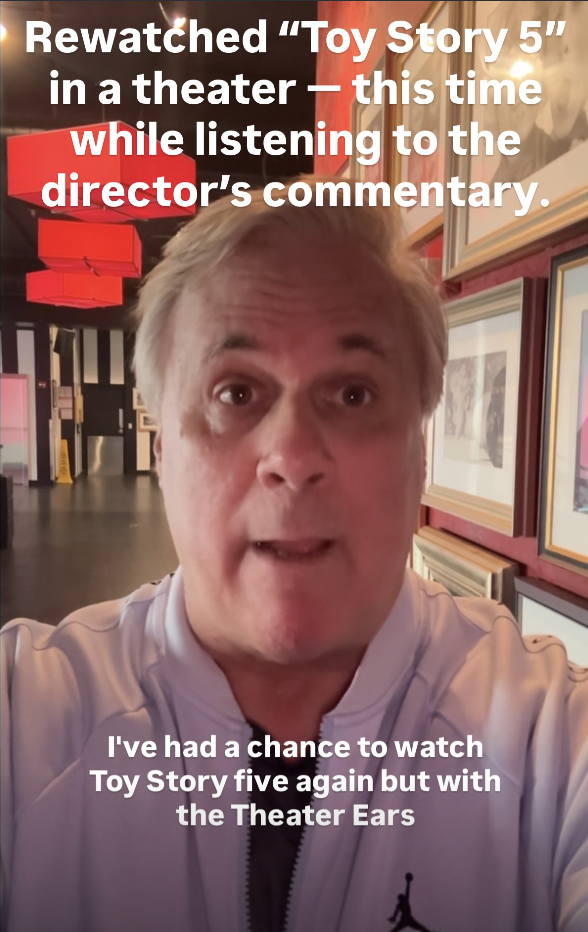
Photo Credit: Instagram - See Original Video Review https://www.instagram.com/p/Db3DcEOxsWe/
By Richard Roeper
August 11, 2026
If you were five or six years old when “Toy Story” arrived in 1995, you’re now old enough to have children of your own who are just discovering Woody, Buzz Lightyear, Jessie the Yodeling Cowgirl, Bullseye and the gang for the first time. Just as Andy and later Bonnie (and before them, Emily) treasured their toys and considered them to be an integral part of their childhoods, generations of children around the world have felt that same connection with the franchise itself.
This is why it’s so cool that the commentary track for “Toy Story 5” features the voices of Pixar Animation artists who have a combined total of more than 60 years at the studio—including two legendary veterans who joined the company in the 1990s, and a relative newcomer who has blazing talent and speaks with such fondness of the human and toy characters in the film that they sound like a proud parent boasting about their children.
Production designer Bob Pauley joined Pixar in 1993 as production commenced on the original “Toy Story,” where he famously designed Buzz Lightyear. Visual Effects Supervisor Thomas Jordan started as an intern on “A Bug’s Life” in 1997 and has risen through the ranks, mastering techniques such as shading, rendering and hair simulations in films such as “Monsters, Inc.,” “Cars,” “Up” and “Brave.” And there’s Kenna Harris, the co-director and co-writer of “Toy Story 5,” who joined Pixar in 2018 and is now one of their rising stars. This combination of experience, talent and unabashed enthusiasm for their work lifts the audio commentary above a mere recitation of Easter eggs. (Though there’s plenty of “inside-baseball” talk as well, and we are going to dive into that a bit later.) From the opening title cards to the closing credits, Harris, Pauley and Jordan fill our ears with a steady stream of commentary that makes us feel as if we’re sitting next to them in a restaurant or coffee shop, or maybe attending a college course in filmmaking, tuning into a lively conversation that celebrates the work and explains how so many tools of the trade are employed.
Bonnie (now voiced with such empathy and humor by Scarlet Spears) is the heart of this story. Now that she’s a bit older, her room has become messier to reflect her age. We’re also told her outfits change throughout the film to reflect where she’s at with her emotions, from trying to make new friends to being bullied to embracing the technology of Lilypad to reconnecting with Jessie and the gang—and making a new, true friend in the equally imaginative and sweet Blaze (voiced by Mykal-Michelle Harris). It’s also fascinating to hear how Jordan and the VFX team were able to use a new simulation system to create “curl awareness” in Blaze’s hair to make sure it was authentic and accurate.
Thanks to new technology, the Pixar team was able to remodel Emily so that she would look like the original version of her they had for “Toy Story 2.” Back then, the limitations were such that “Toy Story 2” Emily was just Andy with a wig. I also learned from the commentary that Pixar will directly borrow and repurpose characters; for example, the deer in “Toy Story 5” is the deer from “Hoppers.”
We’re also reminded that these films take YEARS to make. It took nearly a year to perfect Daffodil, who is Blaze’s “real” horse in the movie. A horse is one of nature’s most physically complex land mammals, so it stands to reason that it would also be one of animation’s most challenging creatures to accurately render.
Just when the commentary starts to go a little too deep into the weeds, we’re treated to anecdotes about some of the acting choices made by the likes of Tom Hanks, Tim Allen and Conan O’Brien, or a lovely grace note, as when it’s noted that in a scene late in the movie where two neighbor children want to play with Bonnie and Blaze, they look both ways before crossing the street. There are subtle lessons about safety and responsibility sprinkled throughout, e.g., making sure the adults don’t break the speed limit when driving, even if they’re in a hurry.
There are a few times when I wished these esteemed artists would take a longer beat to let the movie breathe a bit, and with three voices, the “room” can feel a bit crowded, but Harris, Jordan and Pauley are warm and witty presences whose love for their work and for the characters shines through.
As for those beloved Easter eggs…it’s nearly impossible to keep track of all of them upon a first viewing of “Toy Story 5,” but with a second look and the guidance of the audio commentary, we learn the significance of certain license plates and addresses, we’re alerted to Bonnie’s dad being a fan of classic rock as evidenced by his choice of T-shirts, we note visual references to Pixar staples such as Pizza Planet and Poultry Palace, and we come to appreciate the different animation styles used for Bonnie’s real-world experiences and the playtime sequences taking us inside her imagination. With the audio commentary, “Toy Story 5” becomes “Toy Story 5.1.”