The Odyssey Mythology Versus the Movie: What Christopher Nolan Changed From Homer’s Epic
SEO Title: The Odyssey Movie vs. Homer’s Mythology: Every Major Difference Explained
Meta Description: How accurate is Christopher Nolan’s The Odyssey? Explore the biggest differences involving Odysseus, Penelope, the gods, the Cyclops, Circe, Calypso and the movie’s ending.
Suggested URL: /
Spoiler warning: This feature discusses major events and the ending of Christopher Nolan’s The Odyssey.
For nearly 3,000 years, audiences have listened to, read, translated and reimagined the story of Odysseus.
Christopher Nolan’s The Odyssey continues that tradition on an enormous cinematic scale. Starring Matt Damon as Odysseus, Anne Hathaway as Penelope and Tom Holland as Telemachus, the film follows the king of Ithaca as he struggles to return home after the Trojan War.
The familiar mythology is present: the Trojan Horse, the Cyclops, Circe, Calypso, the Sirens and the violent confrontation with Penelope’s suitors. Yet Nolan’s film is not a literal visualization of Homer’s poem.
It is a reinterpretation.
The ancient epic presents a world governed by gods, prophecies, hospitality and the dangerous intelligence of an imperfect hero. Nolan’s movie shifts much of that emphasis toward trauma, memory, moral responsibility and the human consequences of war.
Some changes are necessary because a movie cannot reproduce all 24 books of Homer’s epic. Others deliberately transform the meaning of the story.
Here are the biggest differences between the mythology of The Odyssey and Christopher Nolan’s movie.
First, There May Not Be One “Original” Odyssey
Before judging whether the movie is accurate, it is important to understand what people mean when they refer to Homer’s original story.
The Odyssey developed from an oral storytelling tradition. Long before the poem existed in the standardized written form studied today, performers recited and adapted versions of the story for different audiences.
Even the identity of Homer remains uncertain. Scholars continue to debate whether Homer was one poet, multiple poets or a name eventually associated with generations of oral tradition.
The earliest surviving physical fragments of the poem were produced centuries after the period in which the epic was probably composed. This means that the surviving text is itself the result of performance, transmission, editing and interpretation.
Nolan is therefore not the first person to alter The Odyssey. Translators, playwrights, poets and filmmakers have been changing its language, structure and emphasis for thousands of years.
The better question is not whether Nolan changed Homer.
He clearly did.
The better question is what those changes accomplish.
Homer’s Odysseus Is Cunning, Proud and Morally Complicated
In Homer’s poem, Odysseus is not simply a noble warrior trying to return to his family.
He is a strategist, liar, storyteller, survivor and manipulator. His greatest strength is often described through the Greek idea of metis: a flexible form of intelligence involving cunning, deception and improvisation.
Odysseus survives situations that stronger warriors could not because he understands how to control information. He disguises himself, invents identities and tells convincing stories whenever doing so benefits him.
But that intelligence is accompanied by pride.
After escaping from the Cyclops Polyphemus, Odysseus cannot resist revealing his real identity. His boast allows Polyphemus to ask his father, Poseidon, to punish him. Odysseus’ journey becomes longer and deadlier partly because he needs recognition for his victory.
Nolan’s Odysseus is a more solemn and psychologically damaged figure.
Matt Damon plays him as a man carrying the physical and emotional consequences of war. The movie emphasizes grief, guilt and the possibility that Odysseus has constructed heroic stories to protect himself from the truth about what he has done.
Several classicists have argued that this transformation reduces the character’s humor, charm and dangerous cleverness. Emily Wilson and Daniel Mendelsohn were among the scholars who criticized the movie for turning Homer’s unpredictable trickster into a more familiar, tormented Nolan protagonist.
The change does not make the movie’s Odysseus uninteresting. It makes him fundamentally different.
Homer asks whether a clever but deeply flawed man can reclaim his home and identity.
Nolan asks whether a traumatized soldier deserves to return to the life he left behind.
The Movie Makes the Trojan War Much More Important
The Trojan War has already ended when Homer’s Odyssey begins.
The poem refers to the war and the Trojan Horse, but it does not present the entire operation as a large opening action sequence. Odysseus’ journey is primarily about the consequences of Troy, not a detailed dramatization of the city’s destruction.
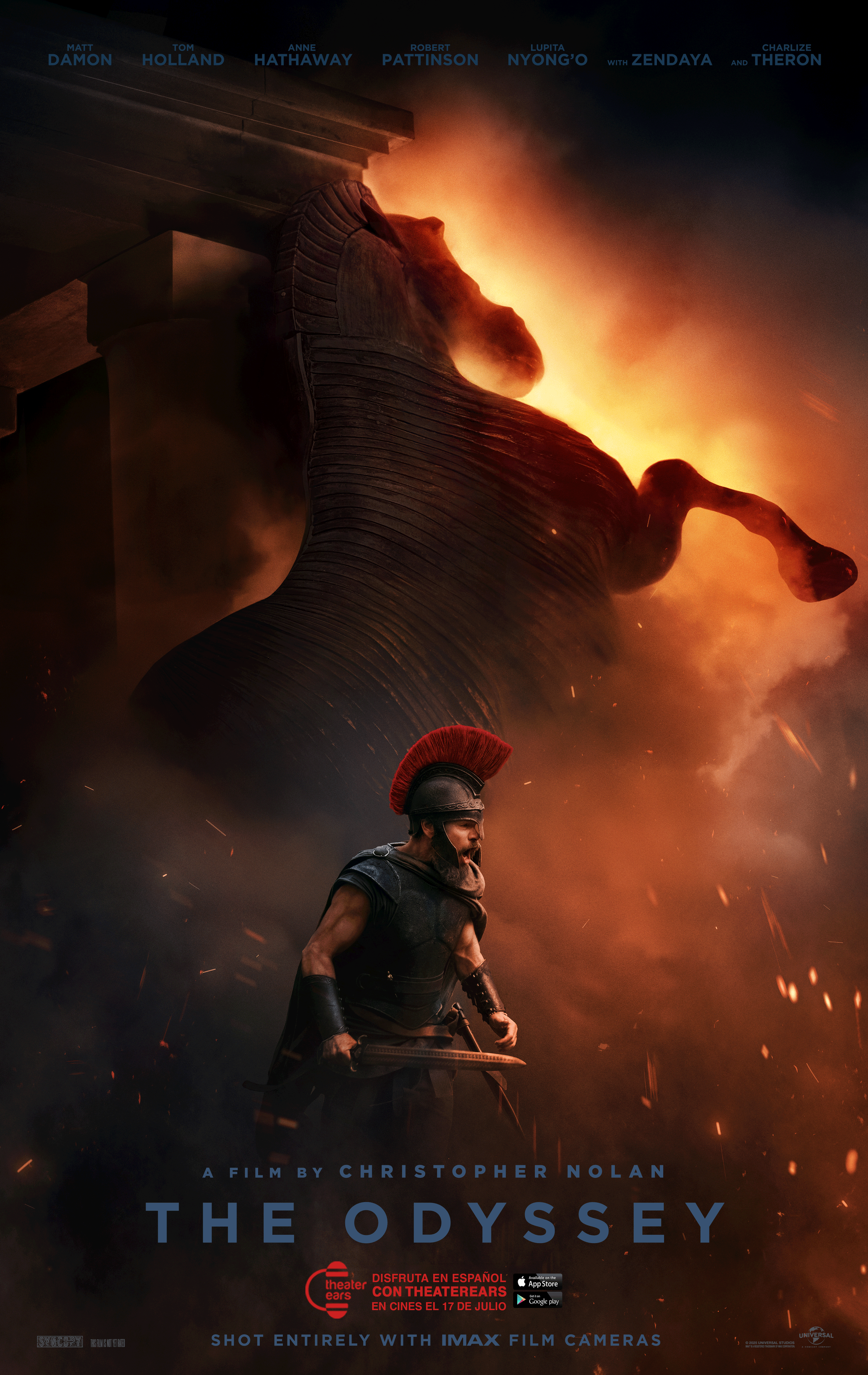
Nolan expands the Trojan Horse into one of the film’s defining sequences.
The movie shows the enormous wooden structure, the infiltration of Troy and the violence surrounding the Greek victory. It also includes Sinon, the Greek who persuades the Trojans to bring the horse inside their city.
Sinon’s full role is more closely associated with Virgil’s Aeneid than with Homer’s Odyssey. Nolan is therefore combining material from different classical traditions to create a more complete cinematic account of Troy’s fall.
This addition serves the movie’s larger purpose.
By showing what happened at Troy, Nolan makes it impossible to separate Odysseus’ journey from the destruction he helped cause. The Trojan Horse stops being merely evidence of his genius. It becomes evidence of his guilt.
The Gods Control Homer’s World—but Not Nolan’s
The gods are active characters in Homer’s poem.
Athena protects Odysseus and guides Telemachus. Poseidon obstructs the journey because Odysseus blinded Polyphemus. Zeus determines when divine intervention is permitted. Hermes carries instructions from the gods. Divine disagreements influence the lives of human beings throughout the story.
Nolan greatly reduces their visible presence.
Zeus and Poseidon are discussed but do not appear as powerful physical beings managing events from Mount Olympus. Athena is presented ambiguously, leaving viewers to question whether Odysseus is encountering a goddess, remembering a woman or experiencing a vision created by trauma and guilt.
Nolan explained that showing distant gods treating human beings like pieces on a board would have created emotional separation. His adaptation instead brings divine forces into the characters’ internal lives.
The difference changes the moral structure of the story.
In Homer, Odysseus suffers partly because Poseidon is angry and the gods have their own competing agendas.
In the movie, suffering appears more directly connected to human choices. Men create wars, destroy cities, abuse power and then live with the consequences.
The gods no longer provide an easy explanation.
The Cyclops Loses One of Odysseus’ Most Famous Tricks
The encounter with Polyphemus is among the most recognizable episodes in Greek mythology.
In the poem, Odysseus tells the Cyclops that his name is “Nobody.” After Odysseus and his men blind Polyphemus, the creature cries out to the other Cyclopes that “Nobody” is attacking him. They conclude that no human enemy is present and refuse to help.
The escape demonstrates Odysseus’ intelligence and love of wordplay.
Nolan’s Cyclops is more physically frightening but less verbally complex. The famous “Nobody” trick is removed, and Polyphemus is portrayed more like a terrifying force than a character Odysseus defeats through linguistic manipulation.
The scene remains spectacular, but its meaning changes.
Homer’s sequence celebrates the hero’s ability to transform language into a weapon.
Nolan’s version emphasizes terror, survival and the vulnerability of human beings trapped with something overwhelmingly powerful.
The movie gains horror but loses some of the wit that defines Homer’s Odysseus.
Circe Has Different Motivations
In the poem, Circe is a powerful divine sorceress who transforms Odysseus’ men into pigs.
With assistance from Hermes, Odysseus resists her magic. He eventually becomes her lover, and he and his surviving men remain on her island for a year.
Circe then becomes an adviser. She tells Odysseus how to reach the Underworld and warns him about the dangers that await him.
The movie retains Circe and the transformation of the men, but changes the emphasis of the episode.
Rather than presenting her primarily as an unpredictable supernatural enchantress, the film connects her hostility to her judgment of violent and destructive men. Her actions become part of Nolan’s broader examination of masculinity, war and the abuse of power.
This version arguably makes her motives more immediately understandable to a modern audience.
However, it also reduces the strange moral ambiguity of Homer’s Circe. In the poem, she can be dangerous, generous, sexual, wise and terrifying without fitting neatly into the role of either villain or ally.
Calypso’s Island Becomes More Psychological
Homer’s Calypso is a nymph who keeps Odysseus on her island for years and wants him to become her immortal husband.
Odysseus is trapped in a complicated relationship. Calypso offers comfort, immortality and escape from human suffering, but remaining with her would mean abandoning Penelope, Ithaca and his mortal identity.
The gods eventually order Calypso to release him.
Nolan’s version places greater emphasis on memory and psychological imprisonment. The film connects Calypso’s control to lotus flowers and to Odysseus’ inability—or unwillingness—to fully remember his past.
The temptation is no longer simply immortality and a beautiful island.
It is oblivion.
Odysseus can avoid confronting the war, the men he lost and the person he became. Returning home requires recovering painful memories instead of merely surviving another sea voyage.
Penelope Is More Powerful in the Poem Than Many Viewers Expect
Penelope is sometimes described as a passive wife who spends 20 years waiting for her husband.
That interpretation ignores much of what she actually does.
In the poem, Penelope uses intelligence and deception to control a dangerous political situation. She promises to choose a new husband after completing a burial shroud for Odysseus’ father. She weaves during the day and secretly undoes the work at night, delaying the decision for years.
Like Odysseus, Penelope survives through strategy.
Their marriage works partly because they recognize the same quality in one another.
The most important example comes after Odysseus returns. Penelope does not immediately accept his identity. She tests him by ordering that their marriage bed be moved.
Odysseus reacts because he knows the bed cannot be moved. He built it around a living olive tree rooted in the ground.
His knowledge proves who he is.
The bed also symbolizes their marriage: living, constructed through shared knowledge and physically rooted in their home.
Nolan replaces this test with an object connected to Athena. The movie’s method is faster and supports its interest in Odysseus’ memories, but it removes one of the poem’s richest images of marriage and recognition. Critics have also argued that the film gives Penelope less control over the story than Homer does.
Anne Hathaway gives Penelope emotional force, but the screenplay makes Odysseus’ trauma more central than Penelope’s intelligence.
The Phaeacians and Nausicaa Are Largely Removed
Homer does not tell Odysseus’ adventures in straightforward chronological order.
The poem begins late in his journey. Odysseus reaches the land of the Phaeacians, where Princess Nausicaa helps him after he washes ashore.
At the Phaeacian court, Odysseus hears songs about the Trojan War and becomes overwhelmed with emotion. He then reveals his identity and narrates many of his famous adventures, including the Cyclops, Circe and the Underworld.
This structure makes Odysseus a storyteller inside his own story.
The audience must consider whether every detail he recounts is completely reliable. His adventures are not merely shown as objective events; they are stories told by a man who is exceptionally skilled at shaping how other people perceive him.
The movie largely removes the Phaeacians and Nausicaa, streamlining the route back to Ithaca.
That decision saves time, but it removes an important layer of uncertainty.
Homer’s Odysseus controls his legend by telling it.
Nolan’s Odysseus is more often confronted by memories that he cannot fully control.
Nolan Grounds the Myth in a Specific Historical Collapse
Homer’s poem contains cultural details from different periods. It does not function as a precise historical reconstruction of one moment in the Bronze Age.
Nolan attempts to place the story more firmly around the collapse of Mycenaean civilization in approximately the 12th century BCE. The movie introduces concerns involving destroyed kingdoms, disappearing trade networks and mysterious “people from the sea.”
This gives the film a historical framework for the chaos surrounding Odysseus’ journey.
Some classicists consider that approach compelling. Others argue that it imposes too much historical specificity on a poem whose power comes partly from combining different eras, places and traditions.
NYU classicist Federica Maria Carlotta Forte argued that Homer’s epic contains multiple layers of time and space that resist being reduced to a single historical setting.
The production’s historical accuracy is also intentionally uneven. One of the most striking examples is Odysseus’ ship, which was represented using a functional Viking longship rather than a reconstructed Mycenaean vessel.
Nolan’s goal is therefore not archaeological precision.
He uses historical imagery to make the mythology feel physically real.
The Movie Removes Some of Homer’s Most Disturbing Violence
Both versions include Odysseus’ return to Ithaca and the killing of Penelope’s suitors.
In the poem, however, the violence continues.
Telemachus executes enslaved women accused of sleeping with the suitors. The disloyal goatherd Melanthius receives an especially brutal punishment. The families of the dead suitors then seek revenge until Athena intervenes and restores peace.
These scenes create serious moral problems for modern readers. Odysseus regains his household, but the restoration is achieved through slaughter, punishment and divine enforcement.
Nolan removes the executions of the women and Melanthius. He also eliminates the final divine intervention that prevents another cycle of revenge.
The change prevents the audience from being asked to celebrate some of the poem’s most troubling brutality.
However, it also simplifies the ancient household politics at the heart of the story. Homer’s Ithaca is not a modern family home. It is a kingdom, economic institution and power structure sustained by enslaved labor and patriarchal authority.
Nolan Completely Changes the Ending
In Homer’s poem, Odysseus proves his identity to Penelope, defeats the suitors and reclaims his position as king.
Athena ultimately intervenes to stop further bloodshed, allowing order to return to Ithaca.
The movie chooses a different destination.
Telemachus becomes king, while Odysseus and Penelope leave Ithaca and sail west. Their departure transforms the meaning of the homecoming.
Homer’s nostos is about returning, reclaiming identity and restoring a disrupted household.
Nolan questions whether restoration is possible.
Odysseus reaches Ithaca, but he cannot simply become the man he was before Troy. His son has grown up. His marriage has changed. His kingdom has survived without him, and the moral consequences of war cannot be erased by winning one final battle.
The movie’s ending suggests that homecoming is not necessarily a return to the past. It may require surrendering power and beginning an uncertain life somewhere else.
Is Nolan’s The Odyssey Faithful to the Mythology?
The answer depends on what kind of faithfulness matters.
The movie includes many of the epic’s most famous characters, monsters and destinations. Odysseus still struggles home from Troy. Penelope still faces the suitors. Telemachus still searches for his father. The Cyclops, Circe, Calypso, Sirens and the violence at Ithaca remain recognizable.
But Nolan alters the forces driving those events.
Homer’s poem is deeply concerned with divine order, hospitality, social obligation, identity and cunning. Nolan’s film concentrates more heavily on war trauma, memory, guilt and the stories societies create to justify violence.
It is faithful to the outline while frequently departing from the ancient poem’s worldview.
That may frustrate viewers hoping to see Homer translated directly into IMAX images. It may also be the reason the movie works as more than an expensive mythology recap.
Which Version Should Audiences Experience First?
Viewers do not need to read the complete poem before seeing the movie.
Knowing the basic mythology can make the adaptation more rewarding, especially when Nolan deliberately changes a familiar character or event. But the film is structured to function as a self-contained cinematic experience.
Reading the poem afterward may be even more revealing.
The contrast makes it easier to recognize what Nolan emphasized, what he removed and how much stranger Homer’s world is than the simplified version of Greek mythology many people encounter in popular culture.
For readers looking for an accessible modern edition, Emily Wilson’s English translation has become especially influential. Nolan has cited her work as an inspiration, even though Wilson has expressed reservations about several of the movie’s choices.
How to Watch The Odyssey in Spanish
The Odyssey opened in theaters on July 17, 2026, and was filmed using new IMAX film technology developed for the production. Universal describes it as the first adaptation of Homer’s foundational saga created for IMAX film screens.
Spanish-speaking moviegoers should check local listings for presentations identified as “En Español” or “Doblada al Español.”
Audiences can also check the TheaterEars app for Spanish-language audio availability. TheaterEars allows users to listen to a professionally dubbed Spanish soundtrack through their own headphones while attending a regular theatrical presentation.
Before going to the cinema:
Download TheaterEars.
Search for The Odyssey in the app.
Download the Spanish audio track before the movie.
Bring a charged phone and comfortable headphones.
Start the experience when the movie begins so the audio can synchronize with the presentation.
Availability can vary, so viewers should confirm that the title and preferred language are listed in the app before purchasing tickets.
The Real Difference Between Homer and Nolan
Homer’s Odysseus wants to return home and become recognizable again: to his wife, his son, his kingdom and himself.
Nolan’s Odysseus discovers that recognition may not be enough.
The movie preserves the voyage but changes its destination. Instead of celebrating the restoration of a heroic king, it asks whether the identity of “hero” was ever truthful—and whether a man responsible for terrible acts can return home without bringing the war back with him.
That is the most important difference between the mythology and the movie.
Homer tells the story of a man reclaiming his world.
Nolan tells the story of a man learning that the world he remembers no longer exists.