The Devil Wears Prada 2 Marketing Campaign: How Fashion, Beauty, Travel, and Influencers Turned a Sequel Into a Cultural Takeover
The marketing campaign for The Devil Wears Prada 2 did not behave like a traditional movie rollout.
It behaved like a fashion season.
That distinction matters. Most studio campaigns are built around trailers, cast interviews, red carpets, and outdoor ads. The Devil Wears Prada 2 did all of that, but it also did something more powerful: it turned the fictional world of Runway Magazine into something audiences could touch, photograph, drink, wear, read, post, and step inside.
The result was one of the most expansive entertainment marketing campaigns of the year — a brand-partnership machine that blurred the line between movie promotion and fashion-week spectacle. Vogue covers, Runway newsstands, red-heel installations, beauty campaigns, beverage drops, automotive tie-ins, airline activations, influencer screenings, and luxury fashion moments all worked together to sell one idea: The Devil Wears Prada was not just back in theaters. It was back in culture.
At the center of the campaign was a smart understanding of what made the original film endure. Fans did not just remember the plot. They remembered Miranda’s coffee order, the cerulean monologue, the Runway office, the impossible assistant dynamic, the fashion closet, the heels, the coats, the fear, the ambition, and the fantasy of being close enough to power to be terrified by it.
The sequel’s marketing understood that perfectly.
The Vogue Cover That Made the Campaign Feel Official
The most symbolically important piece of the campaign was Vogue’s May 2026 cover story featuring Meryl Streep and Anna Wintour. It was the kind of media moment that collapsed fiction and reality in exactly the way The Devil Wears Prada has always invited audiences to do.
The original film was famously linked in the public imagination to Vogue, Anna Wintour, and the mythology of fashion editorial power. By placing Streep and Wintour together in Vogue, the campaign did something no trailer could do: it legitimized the sequel inside the very institution the franchise had long been understood to satirize. Vogue framed the conversation around power, fashion, and performance, and the surrounding issue included related pieces on the film, its stars, and the real-world fashion legacy around Miranda Priestly.
That cover worked because it did not feel like a standard promotional stop. It felt like canon. It turned the promotional cycle into part of the story and gave fans the feeling that Miranda Priestly had not merely returned to theaters — she had returned to the top of the fashion-media food chain.
Runway Magazine Became a Real-World Object
One of the smartest physical extensions of the campaign was the creation of real Runway Magazine assets. The fictional publication has always been one of the most important pieces of the Devil Wears Prada universe. For the sequel campaign, Runway did not remain fictional. It appeared as a tangible object at events, pop-ups, premieres, and influencer activations.
This was powerful because it gave fans something the trailer could not: a prop from the world of the movie that felt like a souvenir from inside Miranda’s office. Reports and social posts described limited-edition Runway magazines being distributed at branded pop-up newsstands in Los Angeles and New York, including activations tied to L’Oréal Paris, Grey Goose, and other partners. The magazine reportedly featured Emily Blunt’s Emily Charlton on the cover and included editorial-style content, ads for brand partners, and fashion imagery from the sequel.
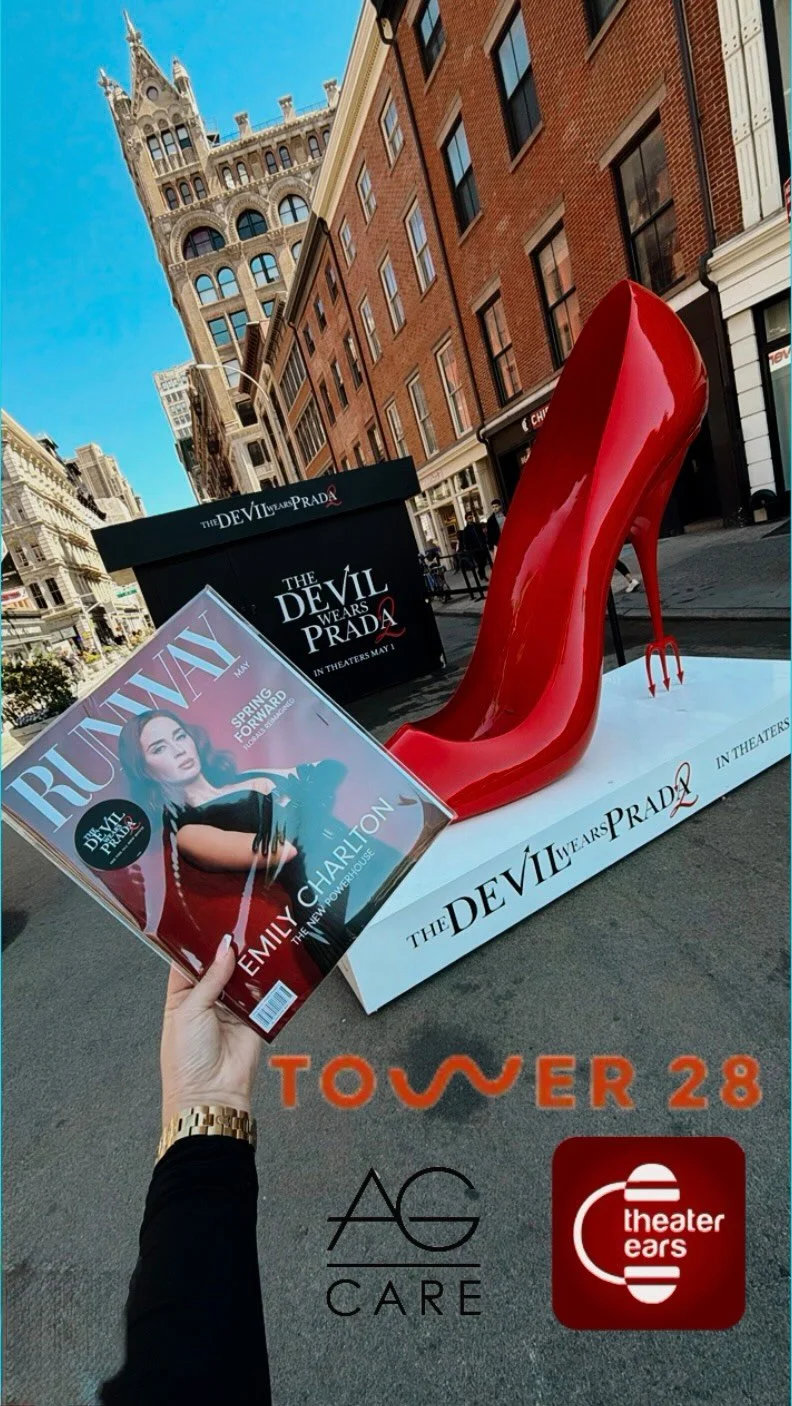
The Runway magazine tactic also showed up powerfully in TheaterEars’ own VIP influencer event at AMC Empire 25 in Times Square on Friday, May 1. Every attendee received a copy of Runway Magazine as part of a swag bag, instantly setting the tone for a fashion-forward screening. That kind of detail matters because it turns an event into a content engine. Guests did not just attend a movie. They arrived inside the world of the movie.
The Red Heels Took the Campaign Outdoors
The campaign’s visual shorthand was the red heel — a simple, unmistakable symbol that could be scaled across posters, social graphics, physical installations, and city activations. Giant red heels appeared in public spaces and pop-up environments, including New York-centered activations that encouraged fans to pose, post, and participate.
The genius of the red heel is that it communicated the franchise without requiring explanation. It was glamorous, sharp, theatrical, and instantly legible on social media. For a film built around fashion, the campaign needed an icon that photographed well from a distance and worked as a selfie magnet. The heel did exactly that.
This is where the campaign most clearly borrowed from the playbook of experiential entertainment marketing. A giant shoe is not just outdoor advertising. It is an invitation. It tells the public: “Stand here. Take the photo. Become part of the campaign.”
Diet Coke Turned Miranda’s Office Pressure Into a Beverage Moment
The Diet Coke partnership was one of the strongest brand fits in the campaign because it understood the Devil Wears Prada workplace fantasy. The sequel’s marketing partners did not simply slap logos onto trailers; many created their own mini-stories inside the Runway universe. Marketing Dive reported that the campaign’s co-branded ads were built around situations that recreated the pressure of the film’s world, rather than relying heavily on clips from the movie itself. Diet Coke’s spot, for example, centered on the small moment of relief the soda provides when an unseen Miranda leaves the office.
Diet Coke also leaned into the fashion language of the film with special-edition packaging, sweepstakes, collaborative merchandise, and a playful “Canny Pack” activation. At the New York red carpet premiere, Diet Coke displayed the Canny Pack in a branded booth, framing it as if it had been designed by fictional designer James Holt. Models in Diet Coke silver dresses also walked the carpet, turning the soda brand into part of the event’s fashion vocabulary.
This is what made the partnership work: Diet Coke did not behave like a sponsor. It behaved like a character in the world.
TRESemmé Made Hair Part of the Runway Fantasy
TRESemmé’s partnership was equally natural because beauty and hair are central to the fantasy of transformation that powers The Devil Wears Prada. The Unilever haircare brand launched a “Get Your Hair on the A-List” campaign around its A-List Collection, starring Paige DeSorbo and fashion designer Christian Siriano. The spot teased TRESemmé’s role as the signature hair brand of The Devil Wears Prada 2 and ran across social, digital, TV, and during the Oscars broadcast.
The brand also launched three special-edition products inspired by the film ahead of its May 1 theatrical release. LBB reported the film-inspired items as “Groundbreaking” Dry Texture Spray, “Runway Ready” Lacquer Shine Spray, and “That’s All” Workable Hairspray — product names that speak directly to the fanbase’s memory of the franchise’s most quotable moments.
This partnership did what the best movie tie-ins do: it turned fandom into routine. A person could buy the product, style their hair, and feel like they were participating in the world of Runway.
L’Oréal Paris Brought Kendall Jenner and Simone Ashley Into Runway
L’Oréal Paris created one of the campaign’s most visible beauty moments with a custom Oscars-night ad starring Kendall Jenner and Simone Ashley. The spot, created by Maximum Effort, recreated the Runway Magazine office environment and played on mistaken identity: Jenner is mistaken for a candidate to become Miranda Priestly’s newest assistant, while Ashley appears as Amari, one of Miranda’s new assistants in the sequel.
The ad mattered for several reasons. First, it used the Oscars broadcast as a high-profile launchpad, giving the campaign prestige placement weeks before release. Second, it connected the sequel to Kendall Jenner’s massive fashion and beauty audience. Third, it introduced Simone Ashley’s new character in a way that felt promotional but still story-driven.
L’Oréal positioned the collaboration around confidence, glamour, humor, and women “who set the standard,” which fits the aspirational core of the franchise. It also brought in the Kardashian-adjacent social ecosystem through Kendall, later amplified by Kris Jenner’s own “Miranda Era” promo content. The Zoe Report noted that Kris leaned into a hybrid Miranda Priestly/Anna Wintour persona, reading Runway Magazine in an office setup and extending the campaign into Kardashian-family social conversation.
Grey Goose Created “The Devil’s Roast”
Grey Goose’s activation was built around one of the franchise’s most famous rituals: the coffee order. The Bacardi-owned vodka brand rolled out a global campaign with original content, pop-ups, specialty cocktails, in-theater activations, and limited-edition packaging. At the center was “The Devil’s Roast,” an espresso-martini-style cocktail inspired by Miranda Priestly’s exacting coffee standard. Heidi Klum fronted the campaign in a spot set within the world of the film.
This was a clever bridge between the office culture of The Devil Wears Prada and the adult nightlife audience that grew up with the original. It also gave bars, premieres, and pop-ups a signature drink that could function as both a menu item and a social post. People do not just share trailers; they share cocktails with a good name.
Starbucks Owned the Coffee Run
If Grey Goose translated Miranda’s coffee obsession into cocktail culture, Starbucks owned the more literal territory: the coffee run. That is sacred ground in The Devil Wears Prada mythology.
Starbucks launched a collaboration in Asia Pacific featuring four drinks inspired by the film’s characters, timed around the movie’s release in select APAC markets beginning April 29, 2026. LBB and License Global also described a secret-menu-style lineup, including Miranda’s Signature Order, Andy’s Cappuccino, Nigel’s Go-To Doppio, and Emily’s Fave Iced Chai. The brand also sent real-life interns and celebrity assistants to iconic New York hotspots in custom “coffee run” coats lined with Starbucks cups.
This activation worked because it converted one of the original film’s most memorable stress symbols into a fan experience. Ordering coffee became a way to play assistant for a day — minus the trauma.
Mercedes-Benz Made Arrival the Message
Mercedes-Benz leaned into a different part of the franchise: power entering a room. The original film featured the Mercedes S-Class, and the sequel reportedly features a lineup of Mercedes-Benz vehicles, including the Mercedes-Maybach S-Class. The brand’s campaign, “The Art of Arrival,” focused on the glamour and authority of showing up. LBB reported that the campaign included a hero film, print and digital visuals, behind-the-scenes footage, and market-specific experiential events across May and June.
License Global added that the partnership functioned as a full-circle moment around the 20th anniversary of the Mercedes-Benz S-Class featured in the 2006 film, and noted that a one-of-a-kind Devil Wears Prada 2-themed Mercedes-Maybach S-Class was planned for premiere activations and marketing events.
For a luxury vehicle brand, the fit was obvious. The campaign was not about transportation. It was about entrance.
Samsung, Google Try On, and the New Tech Layer
The sequel’s campaign also understood that the fashion world of 2026 is not only print magazines and couture. It is also search, smartphones, AI-assisted discovery, and digital try-on.
Samsung launched a global campaign with Cheil Worldwide for the Galaxy S26 Ultra, featuring Helen J. Shen, who appears in the film. The hero spot centers on her character, Jin, narrowly avoiding disaster under Miranda Priestly’s demands. The campaign was also tied to Circle to Search with Google and included a “Runway Cam” red-carpet activation.
At the world premiere, the campaign also created an experiential Runway closet activation where guests were paired with “office staff” and could explore rotating wardrobe options with previews through Google Try On.
This was one of the campaign’s smartest modernizations. It acknowledged that fashion discovery now happens through cameras, search tools, and augmented shopping experiences. Runway may be fictional, but the behavior was contemporary.
United Airlines Flew the Cerulean Skies
United Airlines’ tie-in gave the campaign a travel layer. Live and Let’s Fly reported that United debuted a co-branded ad campaign tied to the film and had a presence inside the movie itself, with multiple flight attendants featured. Marketing Dive also noted that United created an in-cabin takeover placing the film’s red heel logo on the real-time flight map.
This activation was lighter and more playful than the beauty or fashion partnerships, but it made sense: The Devil Wears Prada 2 is a global fashion story, and the press tour, premieres, and fictional Runway universe all depend on movement between cities. United’s red-heel map takeover turned a passive in-flight screen into a tiny piece of campaign storytelling.
Dior, Prada, Louis Vuitton, and Luxury Fashion as Content
Some of the luxury fashion impact came through direct brand integration, while some came through red carpet and editorial coverage. Emily Charlton’s role in the sequel is tied to Dior, with People reporting that Emily is now Dior’s U.S. head in the film’s storyline. W Magazine also tracked numerous fashion Easter eggs and designer references in the sequel, including Dior-related moments.
Louis Vuitton became part of the campaign conversation through red-carpet dressing, including Anne Hathaway’s custom Louis Vuitton look at the New York premiere, widely covered in fashion press and social conversation. Business Insider noted Hathaway’s all-red custom Louis Vuitton gown, matching the red “2” used in the film’s posters. Prada, of course, remains central to the title’s own mythology, and fashion outlets leaned into the brand’s symbolic weight around the sequel’s release, even where the campaign was more cultural association than traditional sponsorship.
The takeaway is that the campaign did not need every luxury house to behave like a conventional advertiser. The cast’s wardrobe, premieres, designer references, and story-world details created organic brand gravity.
TheaterEars Turned a Screening Into an Influencer Engine
TheaterEars’ VIP influencer event at AMC Empire 25 in Times Square was a smaller-scale activation compared with global partners like L’Oréal or Diet Coke, but it was strategically aligned with the broader campaign. It translated the movie’s fashion fantasy into a live social event for Spanish-speaking and bilingual audiences.
The event drew 120 guests on Friday, May 1, with attendees dressed in their best Devil Wears Prada 2 fashion. Every guest received Runway Magazine in their swag bag, along with sponsored hair and skincare products from Tower 28 Beauty and AG Care. The event generated 1 million+ views for DWP2 through event content and related posts, more than 200 Instagram stories, and 30 creator posts and reels. TheaterEars also ranked in the Top 100 Entertainment apps in the U.S. throughout the weekend.
That matters because TheaterEars solved a different part of the campaign puzzle: access. For audiences searching “How to watch The Devil Wears Prada 2 in Spanish,” the app makes the theatrical experience possible even when Spanish-language showtimes are limited.
Download TheaterEars here: https://theaterears.com/download
Why the Campaign Worked
The Devil Wears Prada 2 campaign worked because it did not treat brand partnerships as side deals. It treated them as world-building.
Diet Coke became office relief. Starbucks became the coffee run. TRESemmé became the A-list hair fantasy. L’Oréal became Runway beauty. Grey Goose became Miranda’s coffee order after dark. Mercedes became the art of arrival. United became the cerulean skies. Samsung and Google became modern fashion-tech discovery. TheaterEars became language access and creator amplification.
The campaign understood that the Devil Wears Prada audience does not simply want to watch the world of Runway. They want to step into it, dress for it, drink from it, post from it, and feel briefly as if Miranda might appear around the corner and ask why they are standing still.
That is why the rollout felt so big. It was not one campaign.
It was a fashion ecosystem.