28 Years Later: The Bone Temple: How the Franchise Returns Darker, Bolder, and More Unsettling Than Ever
Few horror franchises have left as deep and lasting a mark on modern cinema as 28 Days Later. When it arrived in the early 2000s, it didn’t just revive the zombie genre — it redefined it, replacing slow-moving monsters with raw speed, psychological terror, and a chilling sense of societal collapse. Now, more than two decades later, 28 Years Later: The Bone Temple arrives as a haunting continuation that feels both timely and terrifyingly intimate.
This new chapter doesn’t aim to simply recreate the shock of the original. Instead, it asks a far more unsettling question: what happens to humanity when survival becomes tradition rather than emergency?
A World That Has Learned to Live With the Infection
28 Years Later: The Bone Temple takes place long after the initial outbreak that devastated the United Kingdom and beyond. The rage virus never disappeared — it became endemic. Entire generations have grown up knowing nothing but quarantines, fortified settlements, and the ever-present threat of infection.
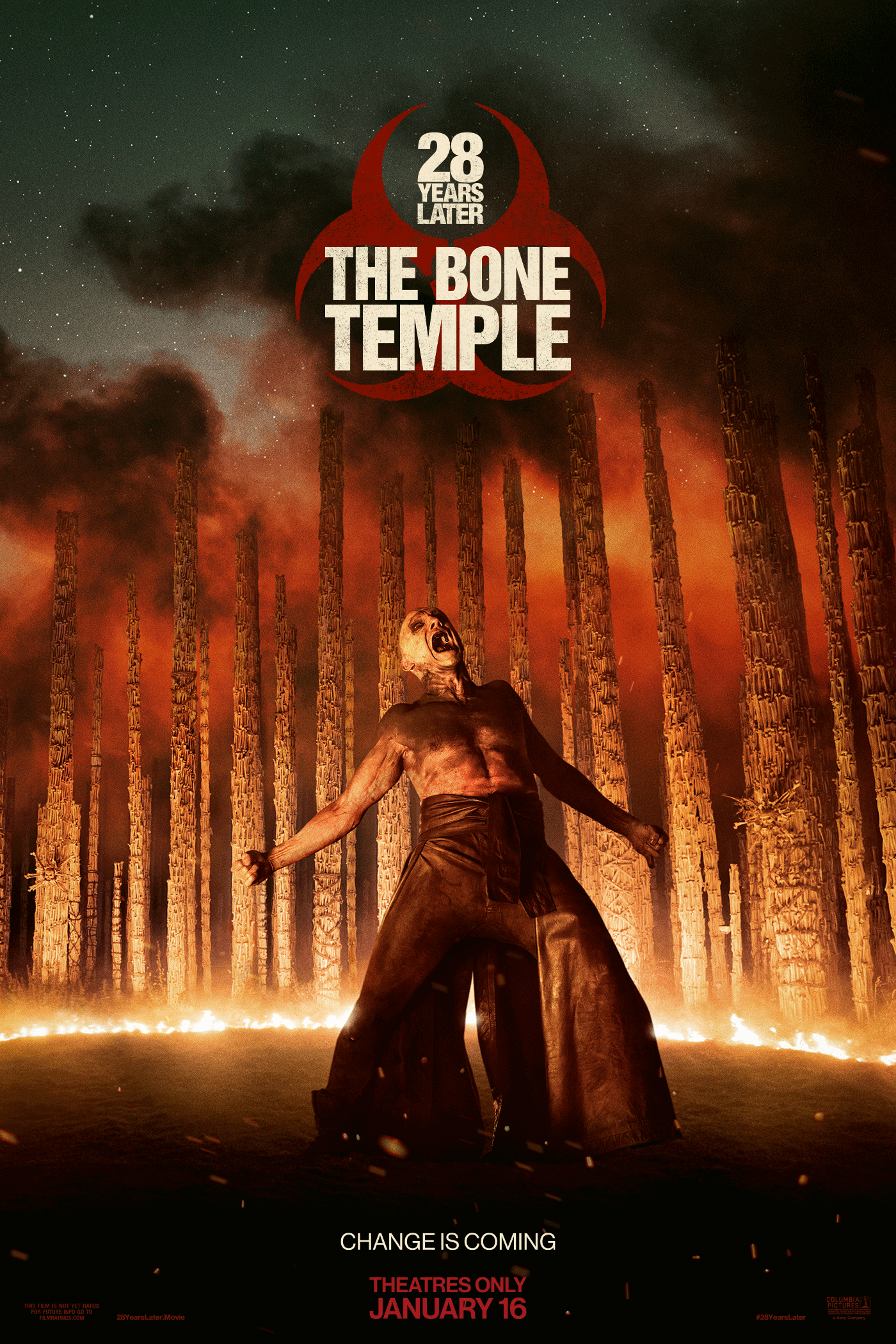
The film’s title refers not just to a location, but to a symbol: a massive, ritualized structure built from the remains of the dead — both infected and uninfected — that has become central to the culture of one surviving community. The Bone Temple represents memory, fear, power, and belief all at once, serving as a chilling reminder that civilization doesn’t simply rebuild — it mutates.
A Shift From Survival Horror to Existential Horror
Where 28 Days Later focused on immediate survival and 28 Weeks Later explored institutional collapse, The Bone Temple ventures into darker philosophical territory. The horror here is less about sudden attack and more about what prolonged trauma does to morality.
Characters are no longer asking how do we survive?
They are asking what are we becoming?
The film explores:
Societies built around fear as a governing principle
Religious and ritualistic responses to catastrophe
The ethics of sacrifice in a resource-starved world
Whether hope is still possible — or even dangerous
This evolution gives the franchise a renewed sense of relevance, especially in a world shaped by real-life global crises.
A Bleak, Beautiful Return to Practical Terror
Visually, The Bone Temple embraces the franchise’s grounded aesthetic while expanding its scope. The film relies heavily on:
Natural lighting
Practical effects
Long, quiet takes that stretch tension to its breaking point
Rather than overwhelming audiences with constant action, the movie lets dread settle in. Silence is weaponized. Empty landscapes feel haunted. When violence erupts, it is sudden, brutal, and deeply unsettling.
The infected remain as frightening as ever — fast, relentless, and terrifyingly human — but the most disturbing moments often come from the choices made by those who are still uninfected.
A Story Designed for the Big Screen
This is not a horror film meant to be discovered casually at home. 28 Years Later: The Bone Temple is designed as a theatrical experience, with immersive sound design, deep shadows, and spatial tension that only fully lands in a movie theater.
For audiences who prefer or need to experience films in Spanish, this is also the kind of release where accessibility matters. Viewers can watch 28 Years Later: The Bone Temple in Spanish at the movie theater using the TheaterEars app, which provides professionally produced Spanish audio tracks synchronized perfectly to the on-screen action.
All that’s needed is a smartphone, headphones, and the free app, allowing Spanish-speaking audiences to fully engage with the film’s intense atmosphere without waiting for limited dubbed screenings.
👉 https://theaterears.com/download
Cultural Relevance in 2026
What makes The Bone Temple particularly effective is how closely it mirrors modern anxieties. The film resonates in a post-pandemic world where ideas like isolation, mistrust, and societal fracture are no longer abstract concepts.
The movie doesn’t offer easy answers or comforting conclusions. Instead, it reflects a harsh reality: survival can preserve the body while slowly eroding the soul.
That thematic boldness sets it apart from many contemporary horror sequels, positioning it less as nostalgia-driven content and more as a continuation with purpose.
A Franchise That Refuses to Go Soft
Unlike many long-running horror properties that dilute their impact over time, 28 Years Later: The Bone Temple leans harder into discomfort. It assumes its audience is ready for challenging material and rewards that trust with a film that is emotionally heavy, morally complex, and genuinely frightening.
It’s a reminder that horror works best when it isn’t just scary — but meaningful.
Final Thoughts
28 Years Later: The Bone Temple doesn’t exist to reassure fans. It exists to unsettle them. By expanding the franchise’s mythology while preserving its raw intensity, the film proves that some stories don’t fade with time — they grow sharper.
In an era dominated by safe sequels and franchise maintenance, this is a rare follow-up that feels dangerous, necessary, and fully alive.
And in true 28 fashion, it leaves audiences with an uncomfortable realization long after the credits roll:
the infection may not be the worst thing that survived.